Introduction:
The immune system is meant to protect the body, but in autoimmune disease, dysregulated T cells can instead generate persistent inflammation and tissue damage. Th17 cells are a major source of the pro-inflammatory cytokines that drive pathogenesis of multiple autoimmune diseases.
Current therapies can neutralize individual inflammatory signals, including interleukin-17 (IL-17). While IL-17-targeting therapies are used clinically to reduce inflammation, they do not necessarily eliminate the disease-causing T cells that produce these signals. As a result, many patients experience incomplete responses or non-durable remission.
Rather than suppressing immunity broadly or neutralizing one cytokine at a time, ai3Bio is building platforms that eliminate disease-causing Th17 cells, and other classes of inflammatory T cells, in vivo and in a single step.
STARx™
Selective T cell apoptosis for autoimmune disease
Short summary
STARx is designed to selectively deplete disease-causing Th17 cells through an apoptotic route of cell clearance associated with tolerogenic signaling.
Platform summary
STARx, or Selective T cell Apoptosis Therapy, is designed to directly eliminate disease-causing Th17 cells and other inflammatory T cell populations. This technology enables an off-the-shelf drug-product that avoids the need for patient-specific cell engineering.
Platform summary
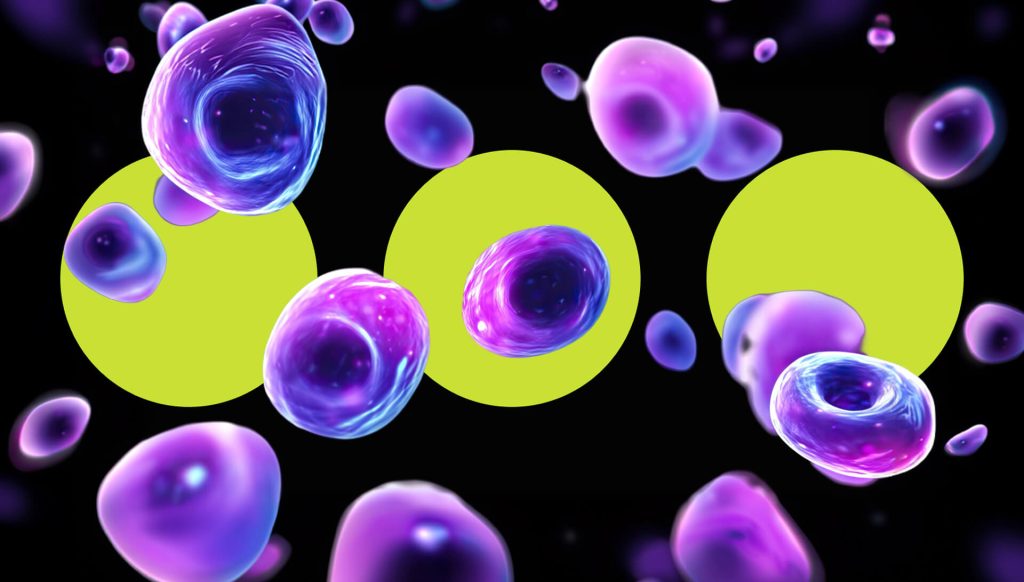
STARx, or Selective T cell Apoptosis Therapy, is designed to directly eliminate disease-causing Th17 cells and other inflammatory T cell populations. This technology enables an off-the-shelf drug-product that avoids the need for patient-specific cell engineering.
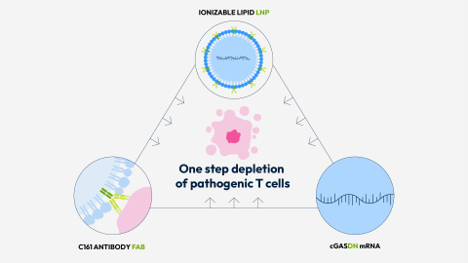
The centerpiece of STARx is a proprietary lipid nanoparticle that delivers therapeutic mRNA payloads specifically to inflammatory T cells in vivo, including IL-17-producing Th17 cells that underlie many autoimmune diseases. T cell specificity is maximized by the attachment of a human antibody that binds the protein CD161. CD161 is highly expressed by Th17 and other inflammatory T cell populations in tissue samples collected from diverse human autoimmune diseases.
Our lead mRNA payload is a proprietary Control-Alt-Delete (CAD) mRNA signal. Akin to the computer command used to reset a malfunctioning system, CAD mRNAs encode proteins that reset T cell-mediated inflammatory dysfunction by initiating immunosuppressive apoptosis within Th17 cells.
Together, these components enable direct, selective depletion of disease-causing Th17 cells in a single step. By inducing apoptosis, STARx eliminates the source of pathological inflammation in a safe and effective manner. The platform provides a precise, scalable approach for T cell-mediated autoimmune diseases.
More about CAD mRNA
CAD (Control-Alt-Delete) is a proprietary mRNA that instructs Th17 cells to undergo cell-intrinsic apoptosis associated with a tolerogenic milieu. The STARx platform uses cGASDN as a CAD signal: a proprietary mRNA payload encoding an engineered form of of the enzyme cyclic GMP-AMP synthase. cGASDN is designed to localize to mitochondria within target cells, where it activates a STING-dependent apoptosis program. The result is direct depletion of disease-causing Th17 cells and other inflammatory T cells.
Publication
1. Barnett KC, Coronas-Serna JM, Zhou W, Ernandes MJ, Cao A, Kranzusch PJ, Kagan JC. Phosphoinositide Interactions Position cGAS at the Plasma Membrane to Ensure Efficient Distinction between Self- and Viral DNA. Cell. 2019;176(6):1432–1446.e11. doi:10.1016/j.cell.2019.01.049. PMID: 30827685.
2. Mosallanejad, K. et al. “Species-specific self-DNA detection mechanisms by cGAS.” Science Immunology 8, eabp9765 (2023). doi:10.1126/sciimmunol.abp9765
3. Mosallanejad K, Kagan JC. Control of innate immunity by the cGAS-STING pathway. Immunology & Cell Biology. 2022;100(6):409–423. doi:10.1111/imcb.12555.
4. Kuhl N, et al. STING agonism turns human T cells into interferon-producing cells but impedes their functionality. EMBO Reports. 2023;24:e55536. doi:10.15252/embr.202255536.